

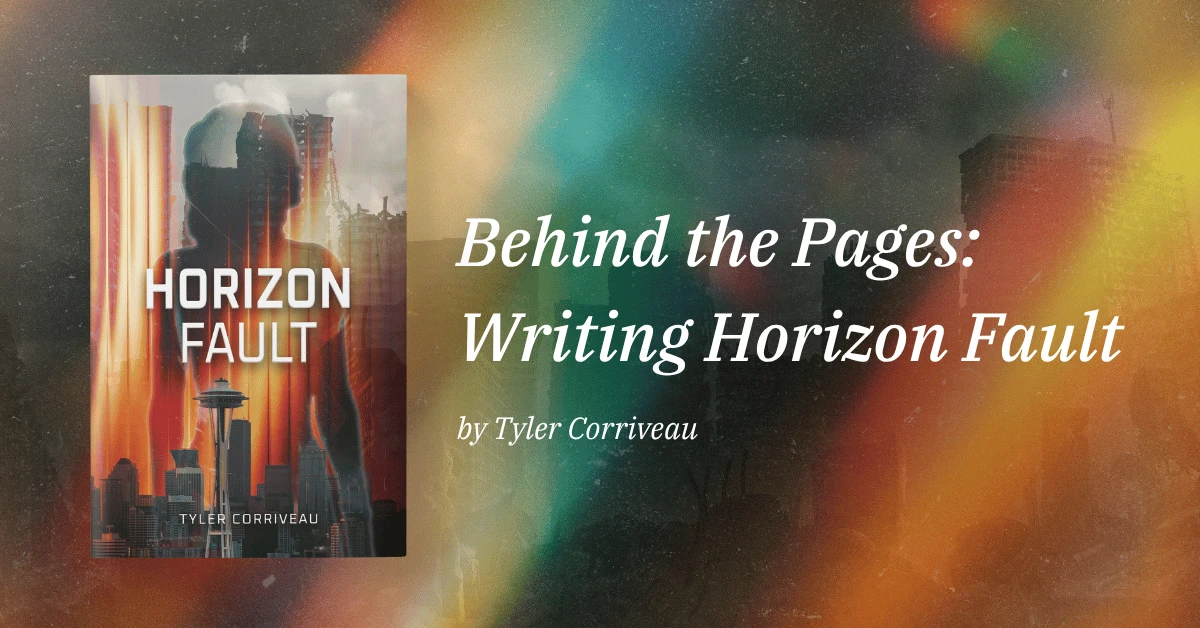
On October 24, 2026, Horizon Fault will be out in the world.
Reaching this milestone hits differently than publishing Book 1. Writing and releasing Transition Age was a fever dream, seeing a world I carried in my head for years finally hit paper. That pride is hard to describe. Readers met the foundation of the trilogy there: the vertical megacities, the state-managed history, a world that traded human agency for stability and called it progress. That reality was something other people could finally step into.
By the time I started drafting Horizon Fault, shortly before Transition Age even released, the trajectory for the second installment of the series was already mapped out. The goal was to crack that foundation wide open. I wanted to expose the corruption, corporate conspiracies, and unpredictability sitting underneath this speculative future.
Opening Horizon Fault's prologue from Detective Henry Calloway's perspective felt like the right entry point. Bringing readers into the precinct before shifting to those interrogation-room exchanges with Iris established the exact framing device needed to thread Books 1 and 2 together. I wanted readers to see that room from inside the institution first: a UFN detective jaded by the governance he serves. Seeing 2159 through his eyes shows how deep the institutional rot actually goes.
From there, the timelines converge and pick back up with Iris, pulling the dystopian and cyberpunk sides of the series to the surface. You get the firsthand account of Eve Mercer and her son Milo living through the collapse of Seattle in 2140, a catastrophe that left the region littered with irradiated ruins and buried secrets. You then get to watch Iris fight for control inside a conspiracy she never asked for, trying to figure out why she and hundreds of other children were taken during the Night of the Vanishing in 2141, and how that connects to what actually happened in Seattle.
Writing across those timelines, perspectives, and storytelling layers was some of the most demanding and rewarding work on this series. Some of my favorite parts of this book came from getting inside Iris's head: her memory recovery, her neural interface link to the Quantum artificial intelligences running this world. That collision of consciousness felt beyond ethereal to piece together.
Horizon Fault pushes the scale of the series further, driving readers straight into the dark layers of this future.
The disaster scenes go back to old manuscript drafts and notes I wrote in middle school and high school. Even back then, I had a real foundation for what it would feel like to live through a structural collapse across a vertical megacity.
That's why the framing at the end of Book 1 and the start of Book 2 mattered so much: it lets Horizon Fault open on a firsthand survival account. Watching a mother fight to get her son out alive says more about resilience than any amount of exposition could.
According to "The Precedent," the official historical record established in Book 1's prologue, the Great Horizon Fault was a system failure. That's the sanctioned version. Dropping readers straight into the street during the actual collapse shows how far off that record really is, and how much interconnected infrastructure can fail at once. It's not just the disaster itself. It's watching how little corrupt governance and corporate power actually care about the people underneath them.
As these characters grew into Horizon Fault, I wanted to play with how mentors and villains can trade places depending on where you're standing. Elias Mercer's worst acts continue to be elusive, never really letting characters or the readers truly understand his motives. Institutional characters also show their real motives underneath the polite agreements they've been hiding behind. And Iris, caught in the middle of a global conspiracy and espionage plot she didn't sign up for, has to figure out how to hold her own ground and come out of it stronger.
Sections of this book were brutal to write. Subjects like mental health, violence, and grief were necessary to show what this future does to the people trapped inside it. The hidden brutality defines this dystopia: dense megacities stacked on top of each other, constant surveillance, no room left for free will, criminal undergrounds running their own agendas in the gaps. A world driven by biotech, runaway science, and artificial intelligence with no interest in preserving what's left of anyone's humanity.
I went through six drafts of this book. Some portions I loved. Others simply pulled the story away from the weight the Fault was supposed to carry, so I went back and rewrote the entire second half. What's now the ending of Part 2, and all of Parts 3 and 4, is completely different than where I started, but it still lands where I always knew it had to.
Readers have known since Book 1 why Iris is sitting in that interrogation room. Calloway's account in the Horizon Fault prologue fills in more of it. And the rest of the book brings everything back to that present moment, where the timelines finally converge on something with no predictable way forward.
That's exactly why I'm excited for readers to get into this one. Everything is left open, which means the final book, The Uncounted, is wide open too.
As I start writing the last installment, I keep coming back to the same thing: nothing here is what it looks like, and a future built on false certainty was never going to hold.
The collapse of trust has only just started.
Tyler Corriveau

Born into a world that believes history has been solved, the first generation of the Transition Age grows up inside cities governed by invisible systems designed to optimize human life. Stability is assumed, choice feels unnecessary, and the past is treated as something distant and irrelevant.