

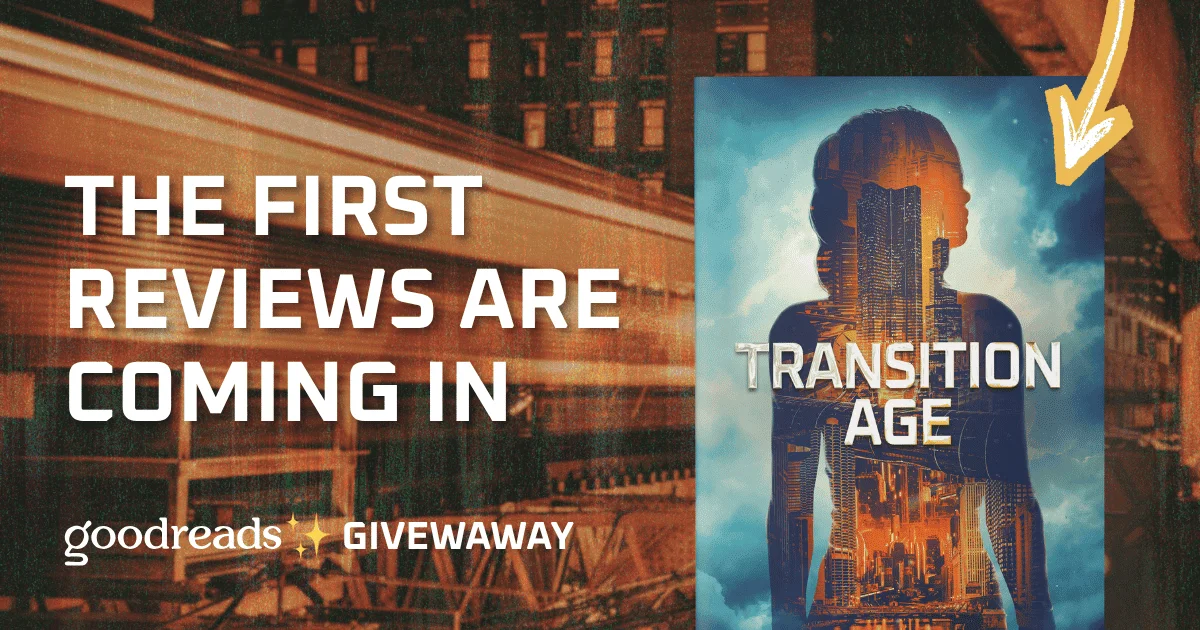
For over a decade, the world of 2159 lived entirely in my head. The towering vertical megacities, the subterranean research labs buried beneath Chicago, and the invisible systems that govern every aspect of human life were all concepts I explored quietly, filling notebooks and hard drives with history timelines and character arcs.
Publishing a novel takes those deeply personal ideas and hands them over to the public. It is a vulnerable process to say the least. You spend years designing a world built on correction and control, but once the book is out there, you have absolutely zero control over how people will experience it.
This past month, the first wave of early reader reviews started coming in. Sitting at my desk in New Hampshire, watching those Goodreads, Amazon, and NetGalley notifications pop up, has been one of the most surreal and rewarding experiences of my life.
Seeing readers connect with Iris Vale and the complex, engineered reality of the Transition Age has been incredible. I wanted to take a moment today to highlight a few of the early review callouts that truly struck a chord with me, and talk about why they mean so much to the overarching vision of the trilogy.
“Vertical cities, AI running everything, people sorted into districts. It felt like a real place, not just a sci-fi set... If you're into sci-fi and you like a good identity thriller mixed in with your dystopia, pick this one up.”
[Read the full review by Andrew W. on Goodreads]
When I set out to write this book, I knew I was balancing two very different genres. I wanted the rich, immersive scale of speculative science fiction, but I needed the urgent, adrenaline-fueled pacing of an identity thriller. Iris Vale does not start her journey with a grand ideological plan to tear down the government. She starts by waking up in a classified facility with no memory of how she got there.
Hearing that the world feels like a real place rather than just a set piece is the ultimate compliment. It means the friction between Iris's human unpredictability and the massive, unfeeling systems of global corporate powered governance is translating exactly as intended. It is a story about a sprawling, algorithmic world, but it is anchored entirely by a fast-paced, deeply personal fight for survival.
“Tyler Corriveau creates a phenomenal world that feels so familiar and uncomfortably close to our own... The reader is right there with [Iris], feeling every bit of her shock, heartbreak, and anxiety.”
[Read the full review by Marina B. on Goodreads]
This piece of feedback gets to the heart of what psychohistorical science fiction is all about, and it touches on the emotional core of the story. The Transition Age is not a fantasy realm disconnected from our reality. It is a direct, albeit extreme, extrapolation of the world we live in today. I wanted the year 2159 to feel uncomfortably close because the technologies that manage Iris's world are just evolved versions of the data structures we interact with every single day.
But beyond the systems, knowing that readers are feeling Iris's shock and heartbreak is incredibly validating. Iris survives by learning to adapt without understanding why her mind feels like foreign territory. Reclaiming a suppressed identity is a terrifying, anxious process, and I am so grateful that readers are connecting with her vulnerability just as much as her resilience.
“Transition Age brings you on an innovative & futuristic journey... This story was fast-paced, great character diaglogue with an intertwined plot... You will certainly want to read more to find out the fate of Iris.”
[Read the full review by Mandy’s Book Nook3 on Goodreads]
While the overarching theme of the trilogy deals with heavy concepts like the cost of trading autonomy for survival, I never wanted the book to feel impossible to finish. The plot needed to move. Iris is a character who learns by doing, adapting on the fly as she scales the social and physical layers of Chicago.
Reading that the dialogue and the intertwined plot kept the pages turning tells me that the pacing hit the right mark. The story is meant to be a complex web where every character interaction and buried secret matters. When Iris begins to remember the things she was engineered to forget, the pace naturally accelerates, and I am thrilled that readers are enjoying the ride and are eager for the next chapter.
To celebrate this incredible early reception and to get the physical book into more readers' hands, I am thrilled to announce an official printed book giveaway!
Starting on April 1st, 2026, and running through April 20th, 2026, U.S. readers can enter to win one of 5 signed print copies of Transition Age.
Because I know how much the bookish community loves to tab their favorite world-building details and character moments, I am making these prize packages special. Each of the five winners will receive their signed copy along with a specialized thank-you note, custom Transition Age bookmarks, and a bundle of annotation goodies to help you mark your favorite moments as you explore the vertical cities of 2159.
You can enter the giveaway directly through Goodreads using the link: https://www.goodreads.com/giveaway/show/436884-transition-age
To everyone who has taken a chance on this debut novel, left a rating, or written a review, thank you. Your words do more than just support an independent author. They breathe life into a world that I have cherished for a very long time.
The Transition Age is just the beginning. The truth is no longer buried, and I cannot wait to show you what happens next.
Sincerely,
Tyler Corriveau

Born into a world that believes history has been solved, the first generation of the Transition Age grows up inside cities governed by invisible systems designed to optimize human life. Stability is assumed, choice feels unnecessary, and the past is treated as something distant and irrelevant.